




.png)
Jasper Marketing
June 3, 2024
How to Write How-To Articles That Drive Results
Struggling to write how-to articles that generate traffic? Focus on helping your readers. This article breaks down how to write a good explainer article.

When executed well, how-to articles establish authority, solve real problems, and guide readers through clear, actionable steps.
This guide breaks down the fundamentals of creating how-to articles that deliver value, improve search visibility, and align with your brand standards. We'll also explore how Jasper's Blog Post Agent can streamline production while maintaining quality and consistency.
What makes a how-to article effective?
Effective how-to articles share several core characteristics:
- Clear problem identification: They address a specific challenge or question that the audience is actively searching for answers to.
- Logical structure: Steps are presented in a sequential, easy-to-follow format that mirrors the actual process.
- Actionable guidance: Each step includes concrete actions readers can take, not vague suggestions.
- Contextual support: Visual aids, examples, and callouts reinforce key points and improve comprehension.
- Audience alignment: Tone, terminology, and depth match the reader's level of expertise and familiarity with the topic.
When these elements come together, the result is content that not only ranks well but also builds trust and drives conversions.
7 steps to writing actionable how-to articles
1. Choose a topic with clear intent
Start by identifying topics that align with your audience's needs and search behavior. Use keyword research tools to uncover high-intent queries—phrases that indicate someone is actively looking for a solution. Prioritize topics where you can provide unique insights or a more comprehensive answer than existing content.
Consider these factors when evaluating potential topics:
- Search volume and visibility: Is there consistent demand for this information?
- Competition: Can you create a more useful resource than what's currently ranking?
- Relevance: Does this topic align with your brand's expertise and offerings?
- Actionability: Can you break the process into clear, manageable steps?
2. Understand your reader's context
Before drafting, consider who will be reading this article and what they need from it. Are they beginners encountering the topic for the first time? Experienced users looking for advanced techniques? Busy professionals who need a quick reference?
Understanding search intent helps you deliver the right level of detail. A reader searching "how to change a tire" likely needs immediate, step-by-step instructions—not a history of automotive maintenance. Cut unnecessary preamble and get directly to the guidance they came for.
3. Draft a structured outline
A strong outline is the foundation of any effective how-to article. Map out the process from start to finish, organizing steps in the order they need to be completed. This ensures logical flow and prevents gaps in your instructions.
Your outline should include:
- Introduction: Briefly state what the article will cover and why it matters.
- Prerequisites: List any tools, materials, or knowledge required before starting.
- Step-by-step instructions: Break the process into discrete, sequential actions.
- Tips and warnings: Highlight best practices or common pitfalls to avoid.
- Conclusion: Summarize key takeaways and suggest next steps.
4. Write clear, actionable steps
Each step should begin with an action verb and describe exactly what the reader needs to do. Avoid passive constructions or vague language. Instead of "You might want to try running a speed test," write "Run a speed test to measure your connection."
Use these techniques to improve clarity:
Be specific: Instead of "Adjust the settings," write "Navigate to Settings > Display and toggle Dark Mode to On."
Anticipate questions: If a step might be confusing, add clarifying details or a brief explanation of why it's necessary.
Keep it concise: Avoid long paragraphs within steps. Break complex actions into sub-steps if needed.
Address the reader directly: Use "you" to create a conversational, instructional tone that feels personal and engaging.
5. Enhance with visual aids and callouts
Visual elements significantly improve comprehension, especially for technical or complex processes. Screenshots, diagrams, and annotated images help readers confirm they're on the right track.
Consider these visual enhancements:
- Screenshots: Show exactly what readers should see at each stage of the process.
- Diagrams: Illustrate relationships between concepts or components.
- Callout boxes: Highlight warnings, tips, or important notes that shouldn't be missed.
- Numbered lists: Reinforce the sequential nature of steps.
- Bold text: Draw attention to critical actions or terms within longer instructions.
6. Include supporting context
While the primary focus should be on the steps themselves, additional context can make your article more valuable. This might include:
- Alternative approaches: If there are multiple ways to accomplish the task, outline the pros and cons of each.
- Troubleshooting tips: Address common issues readers might encounter and how to resolve them.
- Related resources: Link to relevant articles that expand on specific concepts or offer deeper guidance.
- Examples: Demonstrate how the process applies in real-world scenarios.
7. Close with a clear summary
End your article by reinforcing the key steps or outcomes. This helps readers retain the information and provides a quick reference if they return later. If appropriate, suggest logical next steps or related tasks they might tackle.
For example, an article on setting up a WordPress site might conclude by recommending readers explore SEO plugins or content planning strategies next.
Best practices for how-to article structure
Use descriptive headings
Headings should clearly indicate what each section covers. This improves scannability and helps readers jump to the information they need. Use sentence case for subheadings to maintain a clean, professional appearance.
Break up long blocks of text
Dense paragraphs are difficult to scan, especially on mobile devices. Use short paragraphs, bullet points, and numbered lists to improve readability.
Optimize for search and answer engines
Structure your content to perform well in traditional search results and AI answer engines. This means:
- Using clear headings that mirror common search queries.
- Answering questions directly in the opening paragraphs.
- Including relevant keywords naturally throughout the text.
- Providing complete, self-contained answers that don't require readers to click through multiple pages.
Maintain brand consistency
Every how-to article should reflect your brand's voice and adhere to your style guidelines. This ensures a cohesive experience across all content and reinforces brand recognition.
Common pitfalls to avoid
Overloading the introduction
Readers searching for how-to content want answers, not lengthy background information. Keep introductions brief and focused on what the article will accomplish.
Skipping prerequisites
If your process requires specific tools, software, or prior knowledge, state this upfront. Readers who discover midway through that they lack a critical component will feel frustrated and abandon the article.
Using jargon without explanation
Assume your audience has varying levels of familiarity with the topic. Define technical terms or provide context for industry-specific language.
Neglecting mobile users
A significant portion of how-to searches happen on mobile devices. Ensure your content is easy to read and navigate on smaller screens by using short paragraphs, clear headings, and responsive images.
How to scale how-to content with Jasper
For enterprise marketing teams managing high volumes of content, maintaining quality and consistency across how-to articles can be challenging. Jasper's Blog Post Agent streamlines this process by combining structured workflows with brand governance.
How the Blog Post Agent works
The Blog Post Agent generates publication-ready how-to articles grounded in your brand voice, style guide, and audience context. It structures content with scannable headings, integrates relevant insights from your Knowledge Base, and applies consistent formatting—reducing the time required to move from concept to final draft.
Here's how to create a how-to article using Jasper:
- Open the Blog Post Agent and select the Instructional Post template.
- Input key details including your topic, target audience, and any specific points you want to cover.
- Generate an outline using Jasper's AI, or provide your own if you've already mapped out the structure.
- Review and refine the generated draft, adjusting tone, depth, or examples as needed.
- Add visual elements such as screenshots or diagrams to enhance clarity.
- Publish with confidence, knowing the content aligns with your brand standards.
By automating the heavy lifting—organizing ideas, structuring steps, and maintaining consistent voice—Jasper allows teams to focus on strategic refinements and subject matter expertise rather than starting from scratch with every article.
Maintaining quality at scale
Jasper IQ ensures that every article adheres to your brand voice, style guidelines, and audience expectations. This built-in governance layer means you can scale production without sacrificing quality or introducing inconsistencies across your content library.
For teams managing complex content calendars, this capability is essential. It allows you to produce high-quality how-to articles faster, maintain alignment across regions and channels, and free up resources for higher-level strategy and optimization.
Frequently asked questions
How long should a how-to article be?
Length depends on the complexity of the topic. Aim for comprehensive coverage without unnecessary filler. How-to articles can range from 800 to 1,500 words, but more complex topics may require additional depth.
Should I include multiple methods for completing a task?
If there are several valid approaches, presenting alternatives adds value—especially if different methods suit different user preferences or resource availability. Be clear about the pros and cons of each.
How do I optimize how-to articles for search?
Use clear, descriptive headings that mirror search queries, include relevant keywords naturally, and provide complete answers within the article. Structured content with logical flow performs well in both traditional search results and AI-driven answer engines.
How often should I update how-to articles?
Review how-to content regularly to ensure accuracy, especially for topics involving software, tools, or processes that change frequently. Outdated instructions erode trust and reduce search visibility.
How-to articles are a cornerstone of content marketing for a reason: they solve problems, build authority, and drive consistent traffic. By following a structured approach and leveraging tools like Jasper's Blog Post Agent, enterprise marketers can scale production while maintaining the quality and consistency that audiences expect.
Ready to streamline your how-to content creation? Explore the Blog Post Agent and see how Jasper helps marketing teams execute faster without sacrificing quality.

More of the latest & greatest

The #1 Role You Should Hire in 2026 Is a Content Engineer
Content engineering builds the systems that become the foundation for influence in the AI era.
April 1, 2026
|
Loreal Lynch

How To Use the Jasper × Adobe Workfront Integration: Connect Content Creation to Campaign Execution
This guide walks you through the Jasper × Adobe Workfront integration, what it does, why it matters for teams running complex content workflows, and how to set it up so your content moves from creation to execution without the copy-paste chaos.
March 31, 2026
|
Jessica Kennedy
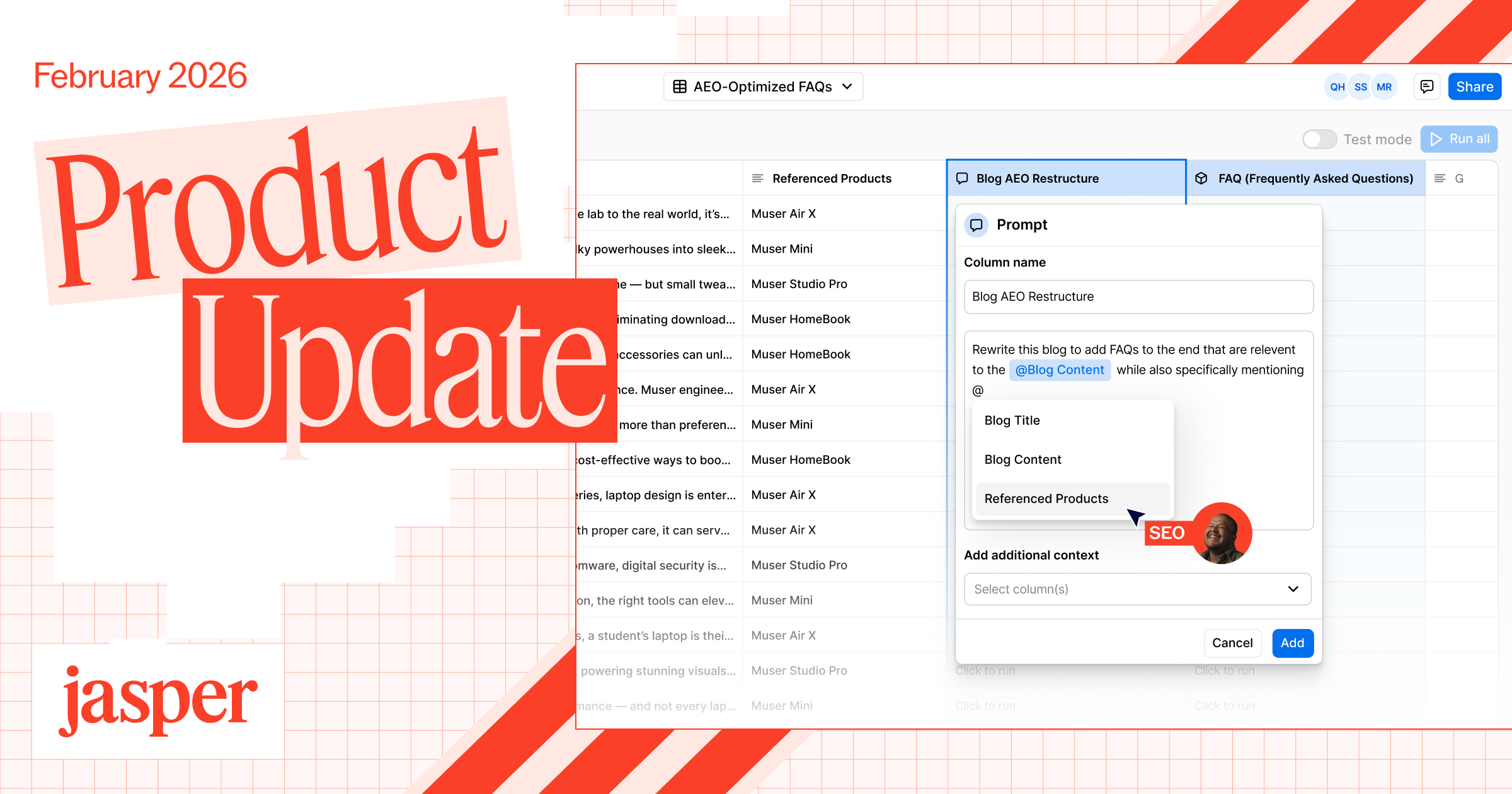
What’s New in February 2026
Scaling marketing with structure and control.
March 6, 2026
|
Mason Johnson